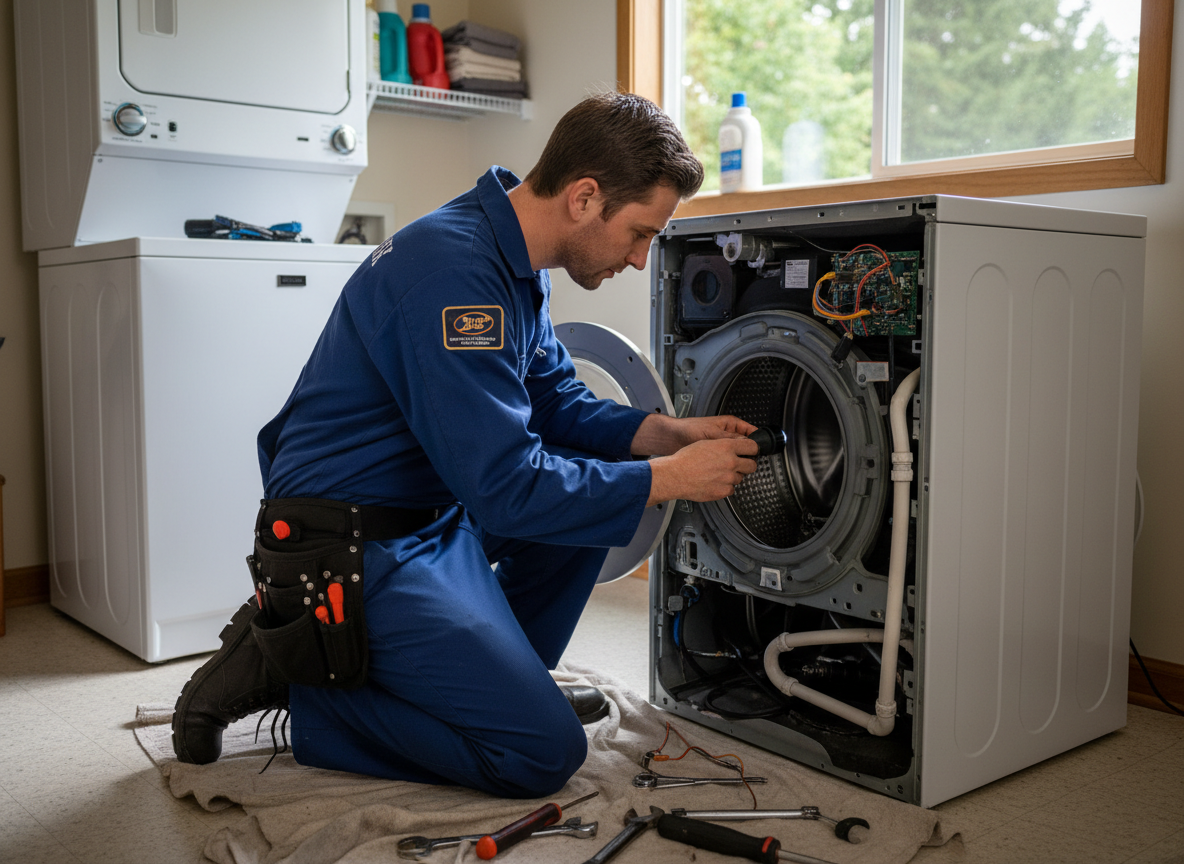
Gresham homes in Rockwood and Downtown often date back decades with laundry setups in basements or utility rooms that sit close to grade. Wet winters bring occasional flooding and persistent humidity that rusts out drain pumps, corrodes wiring harnesses, and packs lint traps with moisture-laden debris. Mild summers do not fully dry these components, so small leaks that would evaporate elsewhere turn into repeated service calls. Technicians working from the 18238 SE Division St address see the same pattern every November through March: front-load washers fail to spin because the drain hose sits in standing water that backs up from saturated soil around Multnomah County foundations.
Dryers in these older homes vent through walls that were not built with modern moisture barriers, so lint mixes with condensation and creates blockages that reduce airflow and trip thermal fuses. Portland’s proximity means many residents also run loads more frequently during the long rainy season, accelerating wear on belts, idler pulleys, and heating elements already stressed by humidity. A tech who has opened the same models in both Gresham and east Portland quickly learns that the same error code can mean two different root causes depending on whether the unit sits on a concrete slab or a raised crawlspace.
Repair work therefore starts with checking the actual installation conditions rather than swapping parts on the first code. That means pulling the unit far enough to inspect the standpipe height against local flood patterns, verifying that vent ducts slope correctly away from the wall, and testing the outlet GFCI that older Rockwood wiring sometimes lacks. These steps prevent repeat visits when winter rains return and water finds the lowest point again.
Common Laundry Setup Issues in Gresham
Older homes near Gresham Pioneer Cemetery and Mt. Hood Community College frequently have stacked units in tight closets with no room for proper ventilation, turning routine dryer repairs into jobs that require moving the entire stack and rerouting ductwork.
Technician insight
In Gresham, the thing that catches most people out with laundry appliance repair is how wet winters push humidity into older Rockwood basements where washers sit on slabs that never fully dry, turning minor drain leaks into rusted motor mounts by the time the first call comes in.
Drain Failure After Winter Storms
A Rockwood homeowner reported their washer would not drain after several weeks of rain. Inspection showed the standpipe had backed up from saturated soil around the foundation. We cleared the pump and hose, raised the standpipe height, and tested the unit through multiple cycles. The washer now empties completely even during heavy winter weather.
How it works
- 1
Initial Assessment
Arrive on site, confirm power and water supply, and document error codes while noting the home’s foundation type and proximity to known flood zones.
- 2
Component Isolation
Remove access panels, test drain pumps, motors, and heating elements, and check for corrosion caused by standing water common in wet winters.
- 3
Part Replacement and Cleaning
Replace failed parts with compatible components, clear lint and sediment from vents and hoses, and verify standpipe height against local drainage realities.
- 4
Final Test and Advice
Run full cycles, confirm no leaks or error codes remain, and note any installation changes needed before the next rainy season.
Pricing
Upfront quotes provided after diagnosis; final cost depends on parts required and time on site.